Components of a Pharmacist Professional Patient Care Practice
Today's pharmacists are medication experts whose services are growing as a result of practice expansion through state laws and regulations, health practitioner collaborations, and sustainable payment for patient care services. Comprehensively defining the key elements of a pharmacist professional patient care practice is vital to foster replicable, standardized, and sustainable pharmacy practices serving the needs of patients nationwide to achieve broader healthcare goals including improved health outcomes and cost-effective care.
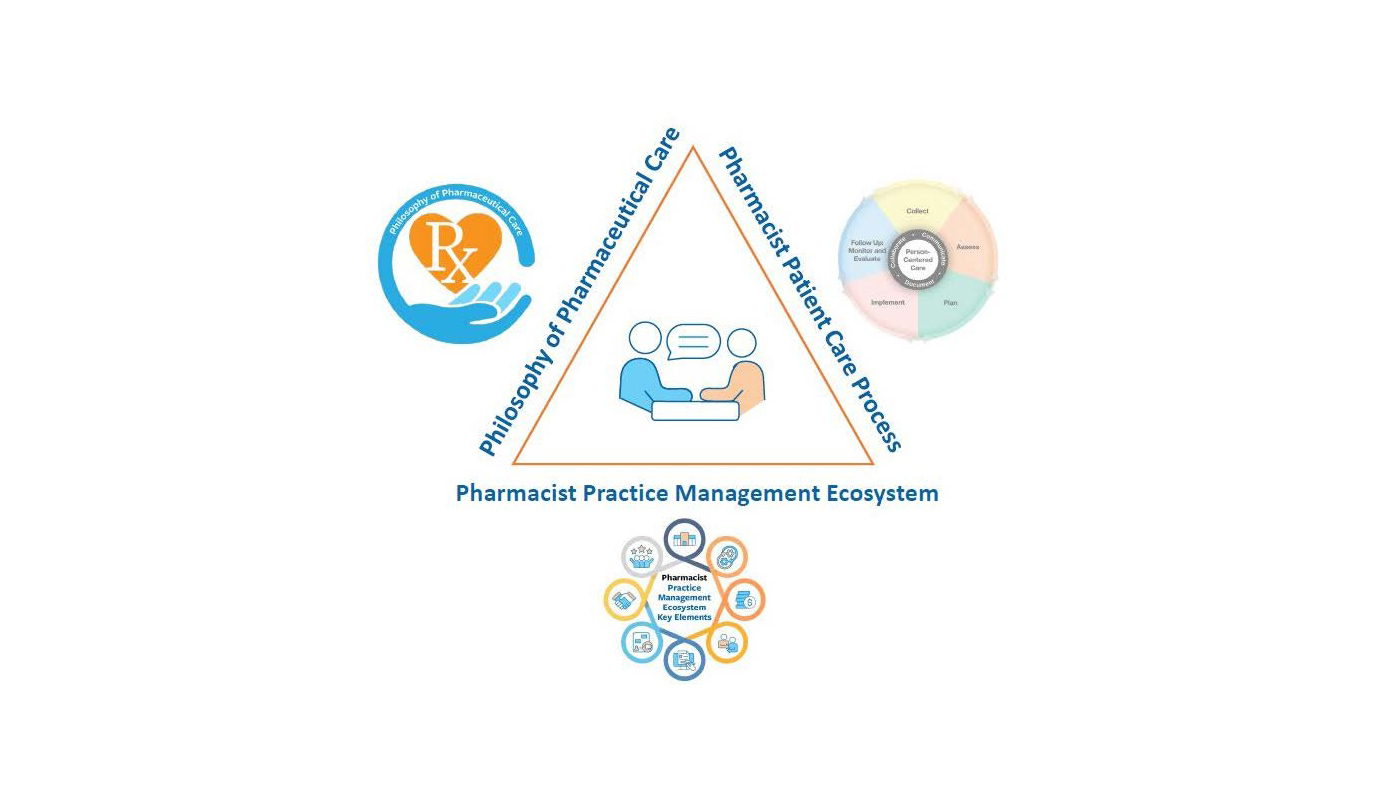
Throughout health care, there are three core components of a professional patient care practice: Philosophy of Practice, Patient Care Process, and Practice Management System. These core components are universally accepted across each health profession. The profession of pharmacy has defined and broadly adopted each of these core components: the Philosophy of Pharmaceutical Care (1990), the Pharmacists' Patient Care Process (2014 and updated 2025), and the Key Elements of a Pharmacist Practice Management Ecosystem (2026).
Philosophy of Pharmaceutical Care
Pharmaceutical Care is a person-centered practice in which the practitioner assumes responsibility for a patient's medication-related needs and is held accountable for this commitment.1 The pharmacy profession recognized the need for unified language of how to directly apply the philosophy of pharmaceutical care to individual patients first through the Core Elements of Medication Therapy Management 1.02 and 2.03, then in 2014 and 2025 through the JCPP Pharmacists’ Patient Care Process4,5, now adopted across all colleges and schools of pharmacy through the 2016 and 2025 ACPE Accreditation Standards6,7.
Pharmacists' Patient Care Process
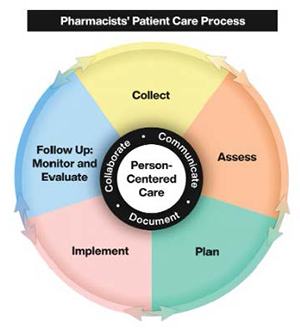
The Pharmacists' Patient Care Process (PPCP) is a consistent and standardized five step process (COLLECT, ASSESS, PLAN, IMPLEMENT, FOLLOW-UP) guided by evidence, clinical reasoning, and complexity of patient needs where pharmacists support patients to meet their medication and health outcomes.5 The PPCP is applicable across all practice settings and modes of delivery (e.g., in person, telehealth), and is optimized when pharmacists have access to contemporary technology capabilities that augment their practice, enable documentation of their services, and allow for secure exchange of patient information through standardized data-sharing solutions.5
More information on the Pharmacists' Patient Care Process can be found on the Joint Commission of Pharmacy Practitioners website.
Pharmacist Practice Management Ecosystem
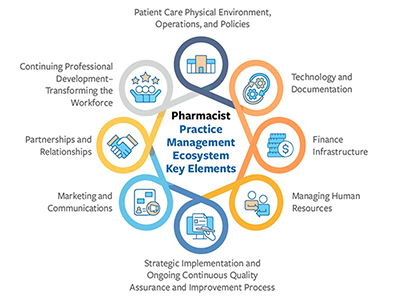
The Pharmacist Practice Management Ecosystem is a dynamic system, grounded in eight interdependent key elements that are needed to establish, maintain, and grow a pharmacist patient care practice in any setting.6 The ecosystem in which the practice operates goes beyond the pharmacy practice itself and is informed by pharmacists, their professional teams, organizational structures, and the surrounding healthcare environment. Pharmacists and their teams engage within the ecosystem to deliver expert medication-related health care while adapting to regulatory, economic, and technological advances, ensuring sustainable patient care services.
More information on the Pharmacist Practice Management Ecosystem can be found on the Joint Commission of Pharmacy Practitioners website.
Citations
- In: Cipolle RJ, Strand LM, Morley PC. eds. Pharmaceutical Care Practice: The Patient-Centered Approach to Medication Management Services, 3e. The McGraw-Hill Companies; 2012.
- American Pharmacists Association, National Association of Chain Drug Stores Foundation. Medication therapy management in community pharmacy practice: core elements of an MTM service (version 1.0). J Am Pharm Assoc2005;45:573-9.
- American Pharmacists Association; National Association of Chain Drug Stores Foundation. Medication therapy management in pharmacy practice: core elements of an MTM service model (version 2.0). J Am Pharm Assoc 2008; 48(3):341-53. doi: 10.1331/JAPhA.2008.08514. PMID: 18595820
- Joint Commission of Pharmacy Practitioners. Pharmacists’ Patient Care Process-May 29, 2014. https://jcpp.net/wp-content/uploads/2016/03/PatientCareProcess-with-supporting-organizations.pdf. Accessed February 6, 2026.
- Joint Commission of Pharmacy Practitioners. Pharmacists’ Patient Care Process-May 20, 2025. https://jcpp.net/wp-content/uploads/2018/10/Pharmacists-Patient-Care-Process-Document-2025.pdf Accessed February 6, 2026.
- Joint Commission of Pharmacy Practitioners. Key Elements of a Pharmacist Professional Patient Care Practice: Pharmacist Practice Management Ecosystem. February 6, 2026. Available at: https://jcpp.net/patient-care-process/jcpp-key-elements-of-a-pharmacist-practice-management-ecosystem.